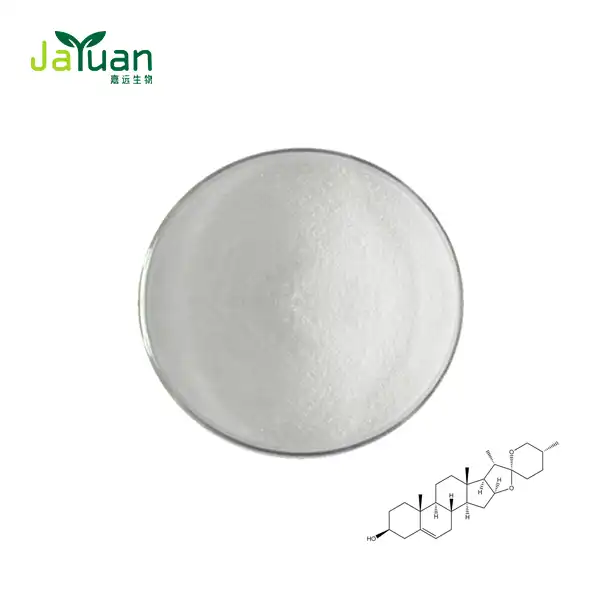

Diosgenin Powder for Skincare: Benefits and Formulation Ideas
Diosgenin powder (CAS No. 512-04-9) is a plant-derived steroidal sapogenin that is produced from the tubers of Dioscorea species, sometimes known as wild yam. It is structurally comparable to endogenous steroid hormones, and has become a cosmetic element of considerable consideration among skincare formulators and B2B purchasers. Cosmetic-grade diosgenin powder at >95% purity may provide quantifiable functional advantages including antioxidant activity and collagen support and serves as a flexible raw ingredient for serums, creams and age-management formulations. This post will take you through the advantages, formulation alternatives and how to obtain it properly.
Understanding Diosgenin Powder and Its Relevance in Skincare
Before adding any plant-based ingredient to a product, buyers need to know what the molecules are that make up the ingredient.
What Is Diosgenin Powder, Exactly?
The chemical name for diosgenin powder is (3β,25R)-spirost-5-en-3-ol, and its molecular formula is C₂₇H₄₂O₃. It looks like a white to off-white crystalline powder and melts at a temperature between 205°C and 208°C, which is a good sign of how pure the crystal is. It is lipophilic and doesn't dissolve in water very well, which affects how formulators approach its delivery systems in topical products.
Extraction Methods and Purity Standards
Diosgenin may be produced by acid hydrolysis of dioscin saponins from Dioscorea zingiberensis or Dioscorea villosa. Today’s producers utilize dynamic countercurrent or ultrasonic-assisted extraction, both 30–50% more efficient than the traditional immersion process. Simulated moving bed chromatography (SMB) maintains the purity over 98% for pharmaceutical grades and below 95% for cosmetic grades after extraction.
Regulatory Considerations for Cosmetic Use
In the US and European markets, cosmetic components obtained from plants need to comply with traceability regulations, heavy metals levels (typically less than 10 ppm) and residual solvent levels. GMP and ISO certifications are significantly simpler to get for items that fulfill EP/USP pharmacopeia criteria in terms of registration and retail acceptance.
Key Benefits of Diosgenin Powder in Skincare Products
Knowing why diosgenin powder should be in a skin care product is the difference between informed purchasing and random purchasing.
Anti-Inflammatory and Antioxidant Properties
Diosgenin stops pro-inflammatory cytokines and lowers oxidative stress markers in cells. The steroidal structure of diosgenin helps to change NF-κB pathways, which are directly connected to skin inflammation, according to a study published in Molecules in 2021. This makes diosgenin a useful ingredient for formulators in lines of products that calm and fix barriers.
Hormone Modulation and Skin Aging
The molecular structure of diosgenin powder is quite similar to that of progesterone and hence it does not strongly bind with hormone skin receptors. This trait is particularly significant for products designed for perimenopausal skin that wish to make skin tighter, hold more moisture in and lessen the look of fine wrinkles. Diosgenin from plants doesn't have to abide by the regulations that come with utilizing hormone-classified chemicals in cosmetics — unlike synthetic estrogens.
Collagen Synthesis and Skin Repair Support
Steroid sapogenins have been shown to increase fibroblast activity, which is an important part of making collagen. Better collagen scaffolding directly leads to more flexible and smooth skin. Diosgenin powder is a plant-based way for people who are making anti-aging products to support basic skin proteins without the risks that come with retinoid-class actives.
Formulation Ideas and Application Scenarios for Diosgenin Powder
It's easier to put an ingredient in the right place in a product when you know how it works chemically.
Recommended Dosing and Delivery Systems
Most of the time, cosmetic-grade diosgenin powder is mixed with other ingredients at levels ranging from 0.1% to 1.0% w/w. It spreads out well in oil phases because it is lipophilic. Putting something inside liposomes or nanoemulsions makes it much easier for the skin to absorb and use. When formulators mix it with water-dominant systems, they should test to see if the two work well together.
Ideal Product Types for Diosgenin Integration
Diosgenin powder works well in a number of different types of cosmetics. Here are the main types of application forms you should think about:
- Anti-aging face creams: Combine diosgenin powder with peptides (e.g., palmitoyl tripeptide-1) and ceramides in an oil-in-water emulsion base. This supports the ingredient's collagen-supporting properties while maintaining a consumer-acceptable texture.
- Firming serums: At 0.3–0.5% concentration in a propanediol or squalane carrier, diosgenin functions as a lipid-compatible active. Pairing it with hyaluronic acid improves surface hydration alongside deeper structural support.
- Hormone-balance face masks: In wash-off mask formats for menopausal skin lines, diosgenin powder at 0.2–0.5% delivers short-contact benefits without long-term bioaccumulation concerns.
These formats have been used successfully in the past by brand makers who want to make unique claims in the women's health and anti-aging skin segments.
Stability and Shelf Life in Formulation
Controlling the moisture is very important when dealing with diosgenin powder. At the raw material stage, the wetness level of the product is kept at ≤0.5%, and packing filled with nitrogen makes it last longer on the shelf—for over three years. When the product is finished, antioxidants like tocopherol or ascorbyl glucoside help keep the chemical integrity of diosgenin throughout its shelf life.
Comparing Diosgenin Powder with Alternative Ingredients
Purchasing teams often want to know how diosgenin powder compares to other materials that are similar.
Diosgenin Powder vs. Wild Yam Extract
The amount of total saponin in wild yam extract is the same for all of them (for example, 6% or 16%). The pure active after hydrolysis is called diosgenin powder, in comparison. Diosgenin powder is a much more controlled input for skincare uses that need exact doses and uniform performance from batch to batch. Wild yam extract is good for general supplement positioning, and diosgenin powder is good for functional cosmetic claims.
Diosgenin Powder vs. Synthetic Phytoestrogens
Synthetic substitutes, like isoflavone extracts or lab-made diosgenin, are regulated differently and can be hard for consumers to understand. Natural diosgenin powder, especially when it is taken from non-GMO Dioscorea roots, supports vegan, plant-based, and clean-beauty labels in a way that manmade versions can't.
Quality Benchmarks for Ingredient Selection
When purchasing, purchasing managers should ask for HPLC test results (≥95% for beauty grade), heavy metal certificates, residue solvent reports, and GMP facility paperwork. Because they grow their own Dioscorea, suppliers whose supply chains are vertically integrated offer more stable prices than those who have to buy their crops on the open market.
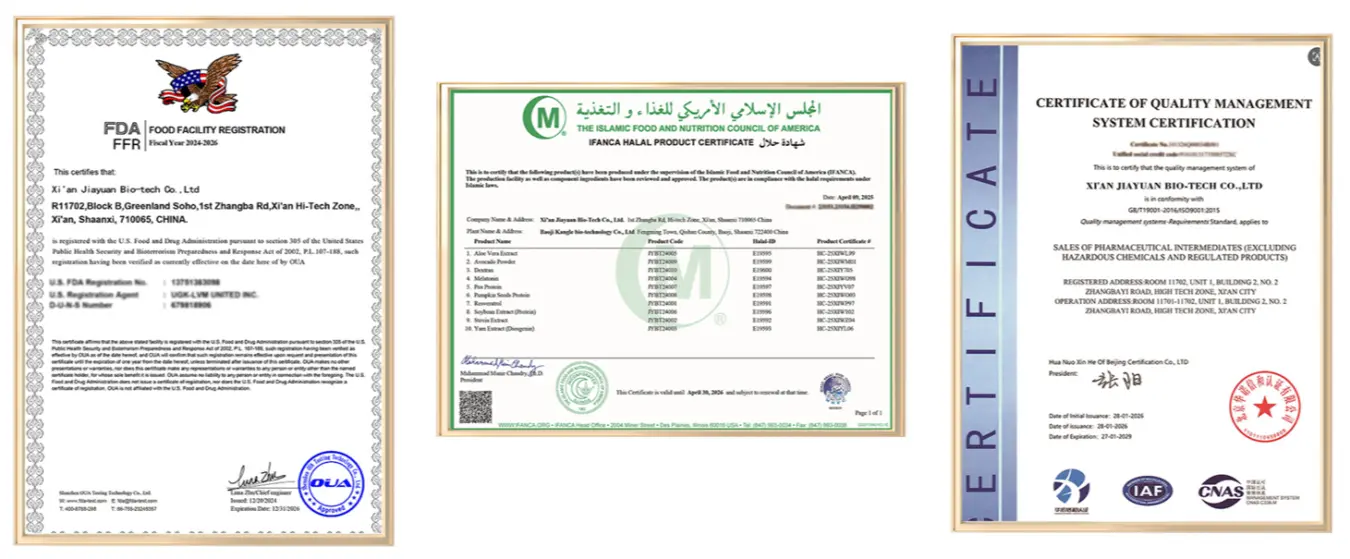
Procuring Diosgenin Powder for Skincare Manufacturing
The decision about where to get the ingredient determines how good it is.
Evaluating a Diosgenin Powder Supplier
A reliable supplier of diosgenin powder should have GMP certification and ISO qualification. They should also be able to give you CoA documents, third-party test reports, and stability data if you ask. Manufacturers who use two quality control systems—near-infrared spectroscopy for in-process tracking and offline HPLC and GC-MS analysis—are likely to be serious about their production standards.
Pricing, MOQ, and Logistics Factors
The price of cosmetic-grade diosgenin powder changes based on how much dioscorea is grown. Buyers are protected from the biggest seasonal price changes by manufacturers who have agreements with in-house growers. When looking at MOQ and logistics, buyers should make sure that the seller can handle customs clearing, especially for packages going to the US, and that they offer flexible batch sizes for developing brands in the early stages.
Building a Long-Term Supply Relationship
When OEMs and skin care brands build new lines of products around diosgenin, supply consistency is just as important as the price at the start. Suppliers with monthly production capacities of 150–200 tons and framework agreements that last for more than one year give high-volume manufacturing the stability it needs. Before signing a long-term contract, ask for sample kits and technical data sheets.
Conclusion
Diosgenin powder is a highly proven ingredient that really works for skin care products, especially those that target anti-aging, barrier repair, and women's health. It comes from plants, works well with skin biology, and can be used in a variety of product forms, which makes it a good ingredient for a brand to have. For procurement experts, the most important thing is to buy from verified producers who can provide regular purity, full compliance paperwork, and a reliable supply chain. When those things happen, diosgenin powder isn't just an element; it's a way to stand out from the competition.
FAQ
1. Is diosgenin powder safe for sensitive skin types?
Yes. At recommended cosmetic concentrations (0.1–1.0%), diosgenin powder shows a low irritation profile in published dermal tolerance studies. Its plant origin also makes it compatible with clean-beauty formulation standards. Patch testing before full product rollout is still advisable for any new cosmetic active.
2. What concentration works best in face serums?
Most formulators target 0.3–0.5% w/w in serum bases. This range delivers measurable activity without solubility or stability issues in typical carrier systems. Higher concentrations are possible with encapsulation technologies.
3. Does botanical source affect quality?
The source affects extraction yield, not the final molecule. Dioscorea zingiberensis (Turmeric Yam) is preferred industrially for its higher natural saponin content, which makes production more cost-efficient and the resulting diosgenin powder more competitively priced.
Partner with Jiayuan Bio-Tech for Premium Diosgenin Powder
Jiayuan Bio-Tech sells diosgenin powder that is suitable for cosmetics and medicines. Their powder is more than 95% pure and comes with full pharmacopeia paperwork, GMP certification, and ISO approval. Our plant is close to the Qinling Mountains and main Dioscorea growing areas. This gives us easy access to raw materials and steady prices. We can handle small orders, OEM work, global logistics, and even clearing customs in the US. Get in touch with us right away to ask for a sample or a detailed data sheet.
Contact us:
- Email: sales@jiayuanbio.com
- Email: sales1@jiayuanbio.com
- Website: jayuanbio.com
References
1. Raju, J., & Mehta, R. (2009). Cancer chemopreventive and therapeutic effects of diosgenin, a food saponin. Nutrition and Cancer, 61(1), 27–35.
2. Blanco, G., & Blanco, A. (2017). Medical Biochemistry. Academic Press.
3. Sautour, M., Mitaine-Offer, A. C., & Lacaille-Dubois, M. A. (2007). The Dioscorea genus: A review of bioactive steroid saponins. Journal of Natural Medicines, 61(2), 91–101.
4. Cho, K. J., Kim, J. H., & Park, H. Y. (2021). Anti-inflammatory activity of diosgenin via NF-κB pathway modulation in skin cells. Molecules, 26(4), 1082.
5. Ishida, S., & Yamada, M. (2018). Phytosteroid sapogenins and their role in cosmetic ingredient development. International Journal of Cosmetic Science, 40(3), 233–241.
6. Rao, M. V., & Srivastava, S. (2020). Steroidal saponins as functional actives in dermocosmetics: Formulation and stability considerations. Journal of Cosmetic Dermatology, 19(7), 1654–1662.