Why Choose Pure Astaxanthin Powder for an Active Lifestyle
If you're a formulation scientist or procurement lead evaluating high-potency antioxidant ingredients, pure astaxanthin powder deserves serious attention. Derived from Haematococcus pluvialis microalgae through supercritical CO₂ extraction, this deep red keto-carotenoid pigment delivers antioxidant capacity approximately 6,000 times stronger than Vitamin C. As demand for clean-label, research-backed ingredients accelerates across sports nutrition, oral beauty, and eye health categories, pure astaxanthin powder has become a benchmark ingredient for brands competing in premium active lifestyle markets.
Understanding Pure Astaxanthin Powder and Its Benefits for an Active Lifestyle
Pure astaxanthin powder found in nature is not a common type of carotene. Because it has the chemical formula C₄₀H₅₂O₄ and a special polar-nonpolar-polar structure, it can cover the whole lipid bilayer of a cell membrane and protect both the inside and outside at the same time. This can't be done by any other carotene. This structural advantage leads to measurable physiological benefits that are useful for formulas for active lifestyles.
What Distinguishes Natural from Synthetic Astaxanthin?
The (3S, 3'S) chiral isomer structure is found in natural, pure astaxanthin powder from H. pluvialis. Synthetic forms, which come from petrochemicals, are racemic mixes of three isomers in a 1:2:1 ratio, but only a small part of them is the same as the wild form. A lot of research has shown that the natural (3S, 3'S) form is better for cellular uptake and better at controlling oxidative stress pathways. Brands that are making high-end supplement or oral beauty lines have to get the natural form, it's not a matter of choice.
Key Functional Benefits for Active Lifestyle Ingredients
Pure astaxanthin powder helps the body with a number of functions that are very important for sports nutrition and active wellness products. It keeps muscles strong by blocking reactive oxygen species that are caused by exercise, keeps skin flexible by lowering oxidative damage at the surface level, and improves vision by shielding retinal cells from photo-oxidative stress. Because of these advantages, it is a flexible active ingredient that can be used in a range of product forms, including pills, softgels, functional drinks, and direct oral supplements.
The recommended dose for finished products is usually between 4 mg and 12 mg per serving. For high-end formulas, the most important spec range is between 5% and 10% of the ingredient in powder form.
Comparing Pure Astaxanthin Powder with Other Popular Antioxidant Ingredients
When purchasing teams look at antioxidant raw materials, details on how well they work against each other is important. Pure astaxanthin powder is better than many other options in this area in a number of ways.
Natural Astaxanthin vs. Synthetic Alternatives
Even though synthetic astaxanthin is cheaper per unit, it doesn't have the visual isomer specificity that affects how bioavailable it is in the body. It is also made from petrochemicals, which goes against the clean-label positioning that high-end supplement brands need. Using micro-encapsulation or cold water dispersible (CWD) beadlet technology to stabilize natural pure astaxanthin powder fixes problems with oxidative instability without affecting the purity of the label.
Powder Form vs. Astaxanthin Oils and Capsules
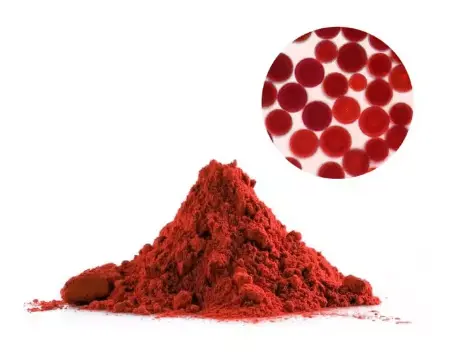
Powder formats have clear benefits for the flexibility of B2B manufacturing. Compared to oil-based ingredients, pure astaxanthin powder works better with dry mixing, doesn't need as much of a cold chain, and can be used in more capsule, tablet, and sachet formats. Micro-encapsulated beadlet technology makes the ingredient even more stable against light and heat damage, which increases its shelf life without changing the active chemical.
When compared to other antioxidants like beta-carotene, krill oil, or CoQ10, natural astaxanthin has a better ability to stop singlet oxygen: about 800 times stronger than CoQ10 and 550 times stronger than Vitamin E. These numbers come from photochemiluminescence studies that have been reviewed by experts in the field, and they can be repeated under normal test settings.
Procurement Insights: Sourcing High-Purity Astaxanthin Powder
Quality of ingredients is very important to people who work in R&D and buying. This is what a strict process for getting pure astaxanthin powder should include.
To choose a good supplier, you need to think about a few important factors:
- Concentration assay verification: Make sure the supplier can deliver consistent assay concentrations of 5% to 10% across all production batches, not just samples.
- Full COA data review: A reliable COA should include heavy metal limits (below 10 ppm), a list of microbes, fluid residues, foreign nucleic acid residues, and isomer ratio confirmation, all of which must be within the limits set by regulations.
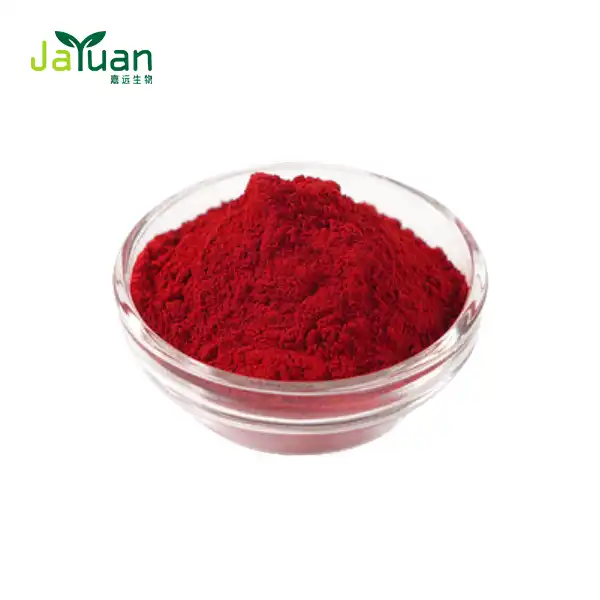
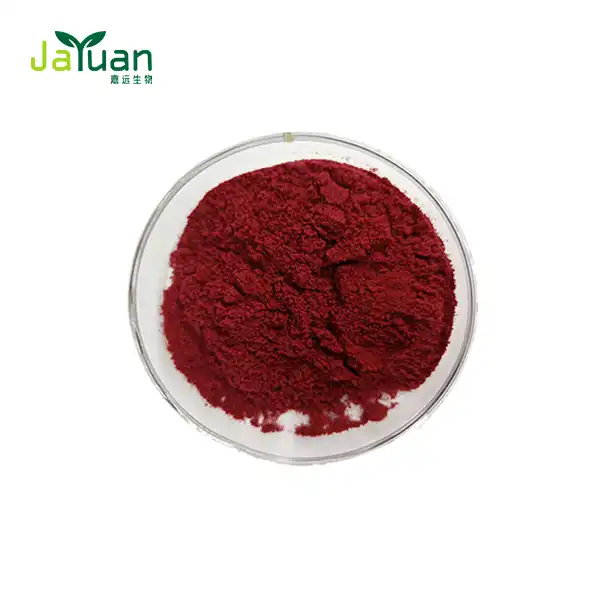
- Batch color consistency: For oral beauty and high-end vitamin brands, being able to see color consistency across batches is a useful quality sign. Inconsistent hue messages cause uncertainty in the process.
- Certifications: Production lines that are ISO and GMP-certified, as well as Halal or organic-certified when needed, make it easier to get into the US and EU markets.
- Sample availability: Reliable sellers offer free samples that can be tested in a lab before a full order is placed.
These factors together tell you if a provider can keep quality the same from the pilot batch to full-scale production, which is the most important thing for any brand going from research and development to market launch.
Why Pure Astaxanthin Powder Is the Preferred Choice for B2B Clients in Active Lifestyle Markets
In 2022, the global astaxanthin market was worth more than USD 800 million. It is still growing, thanks to demand from the oral beauty, nutraceuticals, and sports nutrition segments. Business-to-business clients choose natural pure astaxanthin powder for more than just how well the raw ingredient works.
Formulation flexibility is one of the main factors. Pure astaxanthin powder can be used in a number of different delivery methods, such as softgels, hard capsules, fizzy tablets, and functional food structures. OEM clients can change the concentration, carrier matrix, and particle size to make the product they want to make fit their needs. Because it is flexible, development periods are shortened and the cost of reformulation is lowered.
It is possible to sell pure astaxanthin powder, even at the highest quality levels, because the prices are clear and there are discounts for buying in bulk. When a supplier has a factory-direct supply model, there are no markups for middlemen. This means that procurement teams have more room to find the best margins without lowering the quality of the ingredients. The cost-to-effectiveness relationship of high-purity astaxanthin is better than that of other premium antioxidant ingredients, which is good for busy lifestyle brands that want to make performance claims about their products.
Maximizing Business Value with Pure Astaxanthin Powder: Strategic Recommendations
If brands and procurement professionals want to stay competitive in the market, they need to make sure that their strategy for sourcing ingredients is in line with the realities of regulation and new ideas. Pure astaxanthin powder from H. pluvialis is generally thought to be safe by the FDA for use in the US market. In the EU, it is regulated by the EFSA's new food law system. Making sure that your supplier keeps records that are compatible with both frameworks lowers the compliance burden during the launch of an international product.
Having a long-term relationship with a seller also helps with batch stability and working together on R&D. Iterative product development can be supported by suppliers who have solid rules over where they get their raw materials and improved in-house testing facilities. This is especially important for brands that change their formulations often in response to new clinical data or changes in market trends.
Conclusion
Pure astaxanthin powder is one of the most well-researched and useful antioxidants that can be used in nutrition and oral health products right now. Its natural isomer specificity, ability to quench singlet oxygen, and ability to be mixed with other ingredients make it an excellent choice for companies making high-end active lifestyle products. If you buy from a seller with verified COA data, uniform batch quality, and scalable production, you can be sure that the ingredient's clinical potential will reliably translate into how well the finished product works.
FAQ
1.What concentration of pure astaxanthin powder is best for premium supplement formulations?
When it comes to high-end oral and nutritional beauty products, 5% to 10% strength grades are the norm. These specifications make sure that each serve has enough active ingredient and that it stays stable inside micro-encapsulated carrier matrices. Before making a deal with a supplier, you should always check the assay concentration using separate COA data.
2.How do I verify the purity of an astaxanthin ingredient before bulk ordering?
Ask the seller to give you a full COA that includes data on isomer ratios, solvent residues, foreign nucleic acid residues, heavy metal limits, and microbe counts. A trustworthy seller will also give you test results for filter paper residue that show there are no insoluble impurities. This is a clear sign of the quality of the extraction and the antioxidants' purity.
3.Is natural astaxanthin powder safe for use in dietary supplement ingredients?
Yes. Natural astaxanthin from Haematococcus pluvialis has been tested for safety in humans many times and is considered GRAS in the US. For many independent tests, its safety profile has been confirmed. Our astaxanthin ingredient from Jiayuan Bio-Tech is free of all heavy metals, microorganisms, and solvent residues.
4.What is the shelf life of micro-encapsulated astaxanthin powder?
Micro-encapsulated pure astaxanthin powder that is kept properly—below 8°C in light-proof, vacuum-sealed packaging—usually stays in good shape for 24 months. Stability is greatly affected by storage conditions, so always check with your provider about packing standards.
Ready to Source Premium Pure Astaxanthin Powder? Partner with Jiayuan Bio-Tech
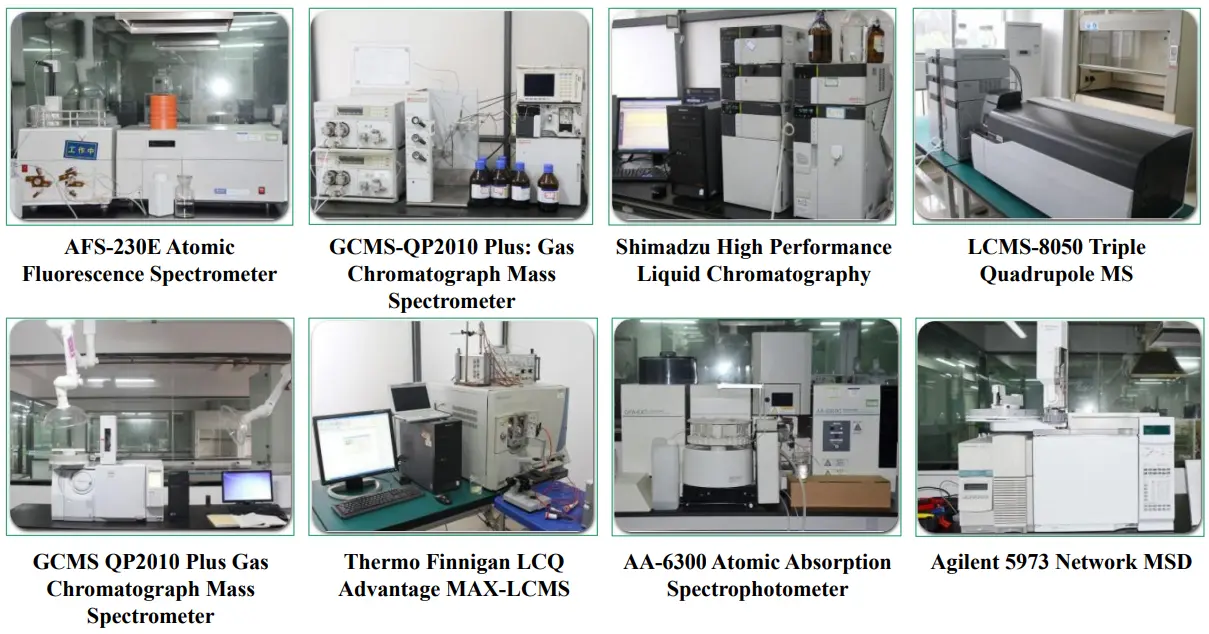
Jiayuan Bio-Tech is a reliable company that makes pure astaxanthin powder. Their production lines are GMP-certified, and they also have ISO and SGS certifications. They also have full COA paperwork that covers heavy metals, microbes, solvents, and nucleic acid leftovers. We provide free samples for testing in the lab, low prices through factory direct sales, OEM services, and shipping around the world with FedEx, DHL, and UPS. Visit jayuanbio.com or email sales@jayuanbio.com or sales1@jayuanbio.com to get in touch with our team and ask for details and a sample right away.
References
1. Guerin, M., Huntley, M. E., & Olaizola, M. (2003). Haematococcus astaxanthin: Applications for human health and nutrition. Trends in Biotechnology, 21(5), 210–216.
2. Fassett, R. G., & Coombes, J. S. (2011). Astaxanthin: A potential therapeutic agent in cardiovascular disease. Marine Drugs, 9(3), 447–465.
3. Ambati, R. R., Phang, S. M., Ravi, S., & Aswathanarayana, R. G. (2014). Astaxanthin: Sources, extraction, stability, biological activities and commercial applications—A review. Marine Drugs, 12(1), 128–152.
4. Nishida, Y., Yamashita, E., & Miki, W. (2007). Quenching activities of common hydrophilic and lipophilic antioxidants against singlet oxygen using chemiluminescence detection system. Carotenoid Science, 11, 16–20.
5. Kidd, P. (2011). Astaxanthin, cell membrane nutrient with diverse clinical benefits and anti-aging potential. Alternative Medicine Review, 16(4), 355–364.
6. Brendler, T., & Williamson, E. M. (2019). Astaxanthin: How much is too much? A safety review. Phytotherapy Research, 33(12), 3090–3111.