

Melatonin Powder vs Gummies: Which Sleep Aid Is Right for You?
If you are a contract manufacturer, private label brand, or functional food producer deciding between melatonin powder and gummy formats for your next sleep product line, this guide is written for you. Melatonin powder — the high-purity crystalline form of N-acetyl-5-methoxytryptamine (CAS No. 73-31-4) — offers formulators precise dosing control, broad format compatibility, and significant cost advantages at scale. Gummies deliver strong retail appeal but come with formulation constraints. Understanding both formats helps procurement and supply chain managers make decisions that protect production schedules and label accuracy.
Understanding Melatonin Supplements
The Biological Role of Melatonin
The pineal gland releases melatonin when it gets dark. It is a naturally occurring indoleamine neurohormone. It tells the body to get ready for sleep by dropping the body's core temperature and making it less active. Studies published in Sleep Medicine Reviews confirm that taking extra melatonin can cut the time it takes to fall asleep by seven minutes on average and make sleep better overall, especially for people who work shifts or travel between time zones.
Common Supplement Formats in the Market
Melatonin can be bought as a sleep aid in the form of powders, capsules, tablets, liquids, gummies, and sublingual sprays. Each style is aimed at a different group of people. Capsules and tablets are common items in pharmacies. Rapid-onset positioning is the goal of liquids and sprays. People like gummies, so they take up most of the store shelves. Melatonin powder, on the other hand, continues to be the most popular input format for manufacturers because it offers the most formulation options for all types of finished goods. When bought from a reputable source, melatonin powder performs admirably in all four tests. It can be used with beverage blending lines, capsule fillers, tablet presses, and gummy molds. This makes it the most flexible raw material for a wide range of sleep products.
Key Factors Procurement Professionals Evaluate
Procurement managers sourcing sleep supplement ingredients typically weigh four factors: absorption rate, dosing flexibility, shelf stability, and total landed cost. Melatonin powder scores well across all four when sourced from a certified supplier. It is compatible with tablet presses, capsule fillers, gummy molds, and beverage blending lines — making it the most versatile raw material for a multi-SKU sleep product portfolio.
Melatonin Powder vs Gummies — Key Differences
Ingredient Composition and Source
Melatonin powder that is used in medicine is completely man-made. It is made through chemical synthesis from indole sources. This gets rid of the risk of viral contamination that used to come with taking out the pineal gland from a cow. Gummies, on the other hand, have the same active ingredient but are made with sugar or sugar alcohols, gelatin or pectin, colorants, and flavorings. Each additive adds a new variable to quality control, marking for regulations, and allergen statements. Bulk powder doesn't have any of these issues.
Dosing Flexibility vs. Fixed-Dose Format
By changing the blend ratio, melatonin powder makers can precisely control doses ranging from 0.5 mg to 10 mg per serve. This is very important for private label customers who want different SKUs, since the same bulk powder lot can be used to make both a 1 mg tablet for kids and an extended-release 5 mg tablet for adults. Once the batch is cast, gummies can't be changed in amount, which means that brands can't make changes after production and have to pay more to redo the recipe if they want to change the strength.
Shelf Life, Storage, and Bioavailability
Melatonin powder will remain effective for almost three years if kept in nitrogen-filled, light-proof metal pouches and maintained at a temperature below 25°C, away from direct sunlight. Gummies have a shelf life of 18-24 months, however they may go bad rapidly if the temperature or humidity changes, which makes international shipment and storage more challenging. Bioavailability statistics (Journal of Pineal Research, 2015) suggest that melatonin absorption is format-agnostic given equal dosages. Which implies that powdered pills and gummies are similar when done well.
Pros and Cons for B2B Procurement and Usage
Supply Chain Trade-Offs: Powder Economics vs. Gummy Market Appeal
It's not just a product choice whether to use melatonin powder or sweets as a production input; it's also a supply chain choice. Here are the main trade-offs that affect how you buy things, plan your production, and manage your margins.
Manufacturers of melatonin powder benefit from:
- Cost efficiency at scale: Ordering from a firm with a 10-ton yearly manufacturing line results in unit prices for bulk melatonin powder that are 40-60% lower than sourcing from small-batch suppliers.
- Formulation versatility: A single powder SKU supports tablets, capsules, soft gels, sachets, and beverage premixes without reformulation.
- Batch consistency: Suppliers using DCS-automated production with online NIR monitoring deliver tighter purity windows — critical when your label claims "3 mg per serving."
- Regulatory simplicity: Fewer excipients mean shorter ingredient declarations and lower allergen review burden.
Benefits of gummy formats for finished product brands:
- Gummies consistently rank as the top-selling supplement format in U.S. retail, driven by consumer preference for taste and ease of use. For brands selling direct-to-consumer, the gummy's market pull is real.
- Gummies support premium pricing due to perceived added value.
Gummies are always the best-selling supplement form in U.S. stores because customers like the way they taste and how easy they are to use. There is a real market pull for gummies for brands that sell directly to customers.- Gummies can be priced higher because people think they are worth it.
Because of these trade-offs, a contract maker with multiple client lines will almost always choose melatonin powder as the source raw material. The choice of gummy shape is a branding decision that comes later.
- Powder handling requires enclosed weighing stations and proper PPE to prevent inhalation of fine particulates.
- Gummy production lines require temperature-controlled casting and higher moisture management.
- Both formats require CoA verification at goods receipt to protect label claim accuracy.
How to Choose the Right Melatonin Supplement for Your Business
Matching Format to Your Production Line
If your business has pill presses or capsule fillers, melatonin powder can be added straight without having to buy any new equipment. If you run a candy line, the gummy format might work with the machines you already have. Most supplement contract makers already make both types of supplements. They get melatonin powder as an input and then divide it up into the finished form that the customer wants.
North American Regulatory and Market Context
Under DSHEA, the U.S. Food and Drug Administration (FDA) oversees melatonin as a part of dietary supplements. Suppliers must show proof that they follow the current Good Manufacturing Practice (cGMP) rules. When buying melatonin powder for the U.S. market, buyers should ask for USP-grade purity certificates, a full Certificate of Analysis (CoA) with HPLC data, and proof that the batch is free of Peak E and Peak X contaminants. This is because of safety concerns raised by the FDA after 1989.
Customization Options and Private Label Strategy
Melatonin powder is the only form that can support more private label placement than any other. Powders of L-theanine, GABA, or magnesium glycinate can be mixed with it to make unique sleep mixes. It's also the base for effervescent sachets and tablets that dissolve quickly under the tongue. Starting with a high-purity melatonin powder ingredient and customizing the delivery method is the most financially flexible way for clients who want to stand out in the sleep supplement market.
Leading Melatonin Powder Brands and Suppliers
Established Brands in the Sleep Supplement Space
Some of the best-known finished-product brands in the U.S. sleep supplement market are Natrol, NOW Foods, Nature's Bounty, Pure Encapsulations, and Source Naturals. These brands focus on packing and distributing their products in stores that people will see. They don't make their own melatonin powder; instead, they use pharmaceutical-grade melatonin powder that comes from reputable raw material sources to make their finished goods.
What to Look for in a Bulk Melatonin Powder Supplier
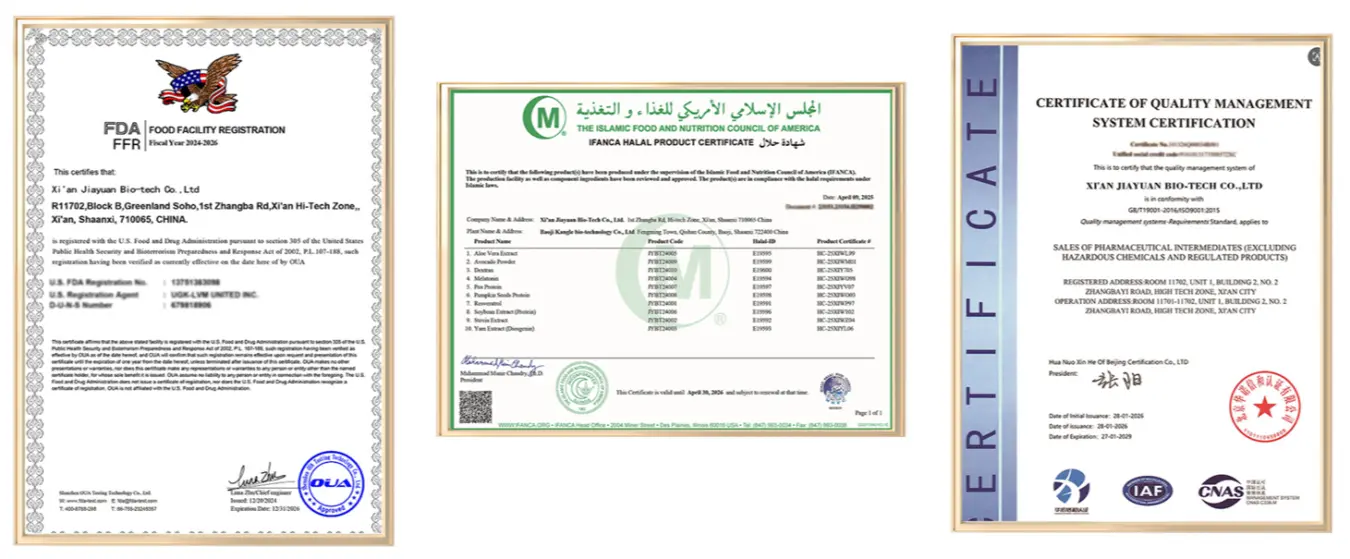
These traits should be present in a dependable melatonin powder supplier for business-to-business purchases. First, proof of purity: HPLC and GC-MS tests show that the product meets USP/EP standards, and the purity level is at least 99%. Second, there are certifications, such as GMP and ISO certifications that meet FDA and EU standards for market entry. Third, batch consistency: automatic production controls make sure that differences in strength between lots are kept to less than 1%. In terms of packaging, there are two sizes of packs: 1 kg and 25 kg, so you can use them for both samples and full production runs. Fifth, supply continuity: a supply chain for raw materials that is vertically integrated protects buyers from price spikes during certain times of the year.
Why Jiayuan Bio-Tech Stands Out as a Manufacturer
Xi'an Jiayuan Bio-Tech makes melatonin powder using simulated moving bed chromatography (SMB) to keep purifying it and keep the purity above 98%. The DCS automated production system precisely controls the pH, temperature, and solvent ratio. This ensures consistency from batch to batch, which protects the claims on your label. The amount of moisture is kept to ≤0.5%, and nitrogen-filled, light-proof packing makes the food last longer than three years. The company Jiayuan Bio-Tech meets the buying standards that production managers need. They have GMP and ISO certifications, pack sizes of 1 kg and 25 kg, and a solvent recovery rate of ≥90% that allows them to offer reasonable bulk prices.
Conclusion
Melatonin powder is the most popular raw material used by companies that make sleep aids in pill, liquid, gummy, and beverage form. When compared to pre-formed chewy ingredients, it gives more accurate dosing, more recipe options, and better cost performance at scale. Gummies are still valuable as a finished customer product, but that choice should be made later. The clear choice for procurement and supply chain managers is an upstream supplier of verified, high-purity melatonin powder with documented batch consistency, USP/EP compliance, and reliable lead times. This will protect your production schedule and label accuracy.
FAQ
1. Is synthetic melatonin powder safe for use in dietary supplements?
Yes, pharmaceutical-grade melatonin powder made by chemical synthesis does not have the biological contamination risks that come with pineal extracts from cows. Each batch should have a COA that says the HPLC study proved that there were no Peak E or Peak X contaminants.
2. What purity level should I require from my melatonin powder supplier?
For use in dietary supplements sold in the U.S., ask for at least 99% purity (USP standard). Every batch of melatonin powder made by Jiayuan Bio-Tech is tested for purity using HPLC and GC-MS to make sure it is at least 99% pure.
3. What pack sizes are available for bulk orders?
The most common business pack sizes are 25 kg (for full-scale production) and 1 kg (for sample and small production runs). Jiayuan Bio-Tech provides both, and their warehouse stocking services help make sure that deliveries happen on time.
Source Melatonin Powder in Bulk — Request a Quote from Jiayuan Bio-Tech
Jiayuan Bio-Tech is a reliable company that makes melatonin powder and sells it to contract makers, private label brands, and healthy food producers all over the United States. Our melatonin powder comes in 1 kg and 25 kg packs and is priced competitively when bought in bulk. It is GMP certified, comes with full COA documentation, and comes with door-to-door logistics support that includes clearing U.S. customs. Email us at sales@jayuanbio.com, sales1@jayuanbio.com, or jayuanbio.com to get a sample or a quote for a large order.
References
1. Brzezinski, A. (1997). Melatonin in humans. New England Journal of Medicine, 336(3), 186–195.
2 .Ferracioli-Oda, E., Qawasmi, A., & Bloch, M. H. (2013). Meta-analysis: melatonin for the treatment of primary sleep disorders. PLOS ONE, 8(5).
3. Hardeland, R., Tan, D.-X., & Reiter, R. J. (2009). Kynuramines, metabolites of melatonin and other indoles. Journal of Pineal Research, 47(2), 109–126.
4. Auld, F., Maschauer, E. L., Morrison, I., Skene, D. J., & Riha, R. L. (2017). Evidence for the efficacy of melatonin in the treatment of primary adult sleep disorders. Sleep Medicine Reviews, 34, 10–22.
5. U.S. Pharmacopeial Convention. (2023). USP–NF Monograph: Melatonin. United States Pharmacopeia.
6. Kostoglou-Athanassiou, I. (2013). Therapeutic applications of melatonin. Therapeutic Advances in Endocrinology and Metabolism, 4(1), 13–24.
You May Like
0