
Ergothioneine Powder for Skin Health: What Research Suggests
The research around ergothioneine powder has gained tremendous momentum in the past 10 years, and its distinctive biological behaviour is closely watched by scientists and formulators alike. Unlike many antioxidant actives that degrade rapidly in aqueous conditions, ergothioneine powder retains structural integrity over a wide pH range (3.0–9.0), and shows remarkable heat stability. It’s taken up into human cells by a specific transporter protein, OCTN1, which concentrates it right where oxidative pressure is greatest — including skin tissue. The research picture is strong and increasingly hard to ignore for formulators and ingredient merchants looking at next generation antioxidants.
Understanding Ergothioneine Powder and Its Role in Skin Health
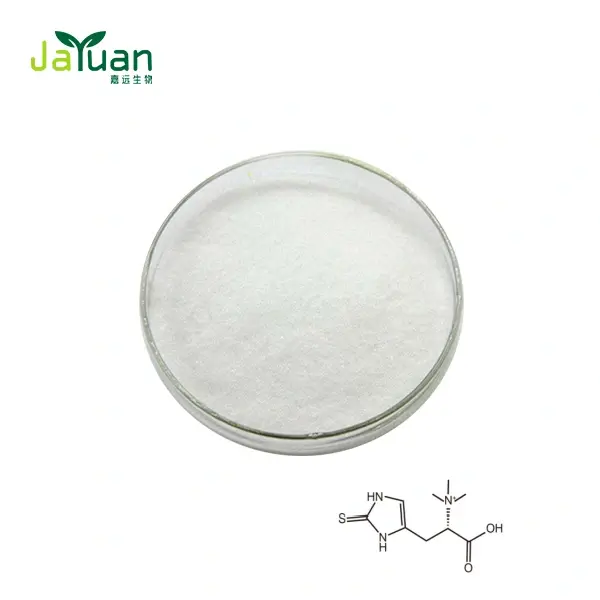
Ergothioneine powder is a natural and sulfur-containing amino acid product produced by mushrooms, mycobacteria, and certain actinobacteria. Humans can’t produce it by themselves, therefore the only way it can accumulate is by external or oral release. Molecular formula is C9H15N3O2S. Molecular weight is 229.3 g/mol. The thiourea ring structure is different in biochemistry than other antioxidants. It prefers the thione tautomer at physiological pH values and so random auto-oxidation is not a common event.
How OCTN1 Transporter Drives Cellular Uptake
The genetic code for the OCTN1 (SLC22A4) transporter, which transports ergothioneine powder over the cell membrane and into the mitochondria and nuclei, is expressed in human tissue. The expression level of this transporter in skin cells can be measured. This means that topical ergothioneine powder doesn’t only sit on the stratum corneum, but travels deeper, to where UV damage and environmental contaminants induce oxidative stress. It doesn’t diffuse passively like Vitamin C or Glutathione, but targets mitochondrial accumulation.
Research Evidence on Photoaging and Pigmentation
Studies that have been published, such as those cited in Free Radical Biology and Medicine, show that L-ergothioneine stops the production of reactive oxygen species (ROS) caused by UV light and stops the tyrosinase pathway that causes too much melanin. In tests with formulations, amounts between 0.1% and 1.0% have been shown to lower oxidative markers and make skin tone more even. This information is useful for formulators who are making whitening serums or photoprotective creams.
Ergothioneine Powder Antioxidant Properties and Skin Applications
Not only is ergothioneine powder potent, but it also lasts a long time in real-life formulation conditions. In open water systems, glutathione breaks down quickly. Stabilization methods for vitamin C are more complicated and cost more. Ergothioneine powder stays stable without those steps, which lowers the risk of formulation for R&D teams that are working against a tight schedule.
Synergistic Behavior with Other Antioxidants
Ergothioneine powder works with other antioxidants instead of against them. It has been shown to protect keratinocytes from oxidative stressors even more when mixed with Vitamin E or Niacinamide in in vitro studies. This behavior that works together is especially good for complicated serum recipes where different active ingredients need to work together without making each other unstable.
Here are the primary skin-relevant benefits supported by current research:
- Mitochondrial DNA protection: Ergothioneine powder builds up in mitochondria through OCTN1 and stops ROS from damaging mitochondrial DNA during cellular respiration. This is an action that most normal cosmetic antioxidants don't have.
- Anti-inflammatory modulation: Skin Pharmacology and Physiology research shows that ergothioneine powder lowers the expression of pro-inflammatory cytokines in UV-stressed skin models. This supports its use in products for sensitive skin and healing after exposure.
- Hydration and elasticity support: Ergothioneine powder indirectly helps maintain skin elasticity and moisture retention over time by lowering the oxidative damage to proteins found in the extracellular matrix, like collagen and elastin.
These processes have real-world design value. This ingredient is very useful because it can be used to make a brightening essence, an antioxidant-rich moisturizer, or an oral supplement capsule. It is hard to get the same results with actives that only work in one way.
Comparing Ergothioneine Powder to Other Skin Health Actives
Purchasing teams regularly compare ergothioneine powder to known ingredients. The comparison is important because the cost of the raw materials has to be explained by how well they work. Here is a realistic evaluation of how EGT stacks up against popular options.
| Ingredient | Stability in Aqueous Formula | Cellular Transport Mechanism | Key Skin Benefit |
|---|---|---|---|
| Ergothioneine powder | Very good (pH 3–9) | In use (OCTN1) | Getting rid of ROS and protecting mitochondria |
| Glutathione | Not Good (it breaks down quickly) | Not active diffusion | Brightening and getting rid of free radicals |
| Vitamin C (L-AA) | Poor without helping them | Not active diffusion | Collagen production is supported, brightness |
| NAC | Moderate | Passive spread | What Glutathione Comes From |
| L-Carnosine | Good | Transporters for dipeptides | Stopping glycation |
The stable benefit of ergothioneine powder is not small; it is structural. It doesn't auto-oxidize without an outside catalyst because its thione tautomeric form is preferred. This gives it a shelf-life advantage of over three years when stored properly.
Is it better to use organic ergothioneine powder or ergothioneine powder made through fermentation? The fermentation method, which uses engineered Mycobacterium smegmatis or yeast systems, makes a uniform, animal-free, and scalable product that meets the standards of the EU Cosmetics Regulation (EC 1223/2009). Formulators who offer brands for the European market should make sure that this origin paperwork is clear when they buy the ingredients.
Procurement Guide: Sourcing High-Quality Ergothioneine Powder
To find a trustworthy ergothioneine powder provider, you need to look at a number of important factors. Details about purity, licensing, batch stability, and the ability to change the minimum order all have a direct effect on how the formulation turns out and the business risk that comes with it.
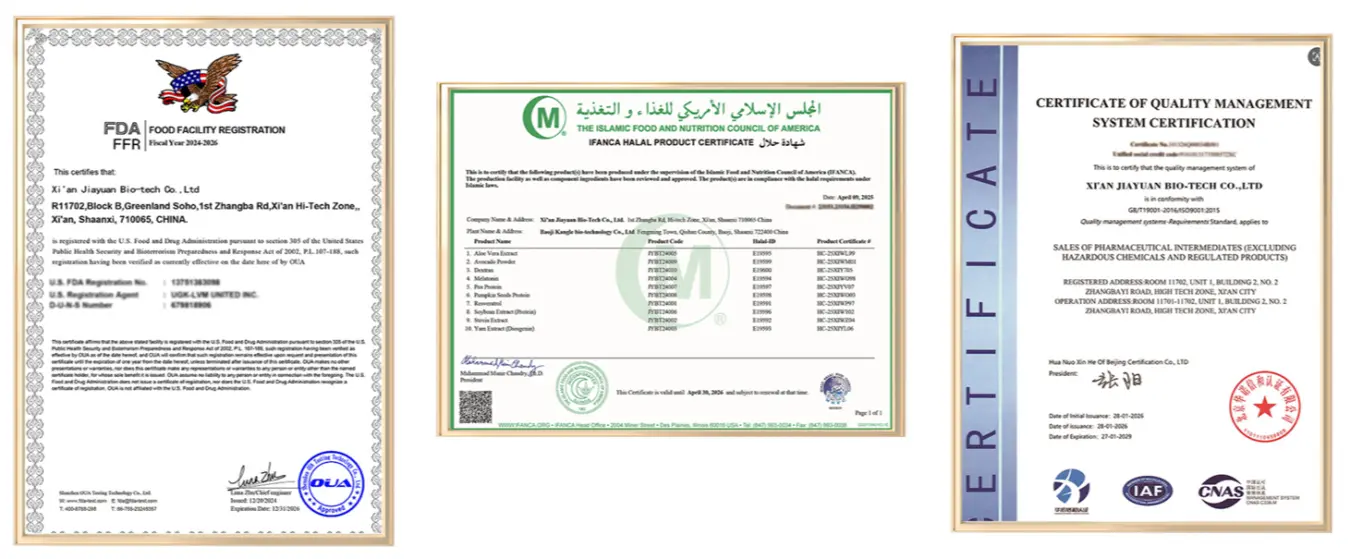
At Jiayuan Bio-Tech, our ergothioneine powder is made on a GMP-approved and ISO-compliant production line using simulated moving bed (SMB) chromatography, which is a continuous purification process that keeps the purity above 98% all the time. Two types of quality control work together to make sure that both EP and USP standards are met. Near-infrared spectroscopy is used for real-time process tracking, and offline HPLC and GC-MS analysis is used for analysis.
Key supply-side advantages we offer to B2B buyers include:
- Cosmetic-grade purity ≥95% and pharmaceutical-grade ≥99%, with chiral purity proven to the only L-isomer (optical rotation +122° to +126°), making sure that every batch has the most biological activity possible.
- Starting from 1 kg sample orders, we can help with formula screening and stability testing before committing to a large order—a critical freedom for brand formulators and distributors who work with mid-size regional names.
- Moisture content ≤0.5% with nitrogen-filled, sealed packaging makes the shelf life longer than three years, lowering the risk of spoiling along long supply lines.
- Vertically integrated raw material sourcing near the Qinling Mountains region keeps prices stable and makes sure there is a steady supply even when the market changes.
- Solvent recovery rates ≥90% and zero liquid discharge (ZLD) wastewater technology are in line with environmental, health, and safety (EHS) standards and are being asked for more and more by supply chains going to the EU.
Because we can produce 10 tons of goods every year, our unit costs are 40% to 60% lower than those of small-batch workshop providers, and we don't have to sacrifice accuracy in the specifications. This cost structure helps buying managers who have to stick to tight budgets for formulations.
Future Prospects and Trends in Ergothioneine for Skin Health
According to data from the cosmetic active ingredients market, the demand for ergothioneine powder is growing at a rate of more than 8% per year around the world. This is because skincare products are becoming more expensive and the overlap between nutrition and beauty is growing. Liposomal delivery, nanoemulsion carriers, and hydrogel frameworks are some of the encapsulation technologies that are being worked on right now to improve the depth of entry and duration of release.
Harmonization of regulations is also making progress. Ergothioneine powder is generally recognized as safe (GRAS) in the US and is mentioned in EU cosmetic ingredient databases. This makes it easier for formulators to enter more than one market at the same time. Premium skin care lines are starting to use ingredient combinations like EGT with Niacinamide, Bakuchiol, or Peptides as high-performance anti-aging stories.
Setting up a stable relationship with an ergothioneine powder supplier now gives ingredient traders and ODM factories a competitive edge when it comes to sourcing, before the product becomes more common.
Conclusion
There is scientific evidence to support ergothioneine powder's place as an antioxidant ingredient. Overall, it is not possible for general antioxidants to match its ability to protect mitochondria, enter cells through OCTN1, and stay stable in water. The proof base is strong and rising for formulation directors who are making unique serums or creams and for ingredient traders who are selling to local brand clients. Today's choices about purity, compliance paperwork, and source dependability will affect how well the product works and its legal status tomorrow.
FAQ
1.What purity grade of ergothioneine powder is suitable for cosmetic formulations?
Most people agree that cosmetic-grade ergothioneine powder that is at least 95% pure can be used on the skin in serums and creams. Pharmaceutical-grade (≥99%) is available for brands that need stricter documentation on specifications or want to sell their products in regulated nutraceutical markets. Both grades should be checked using an HPLC test to make sure they are only the L-isomer.
2.Is ergothioneine powder compliant with EU Cosmetics Regulation EC 1223/2009?
Yes, L-ergothioneine made from microbes fermenting sugars is on the list of cosmetic ingredients allowed in the EU. It is also not on the list of substances that are restricted or banned under EC 1223/2009. As proof of compliance, suppliers should give a full Certificate of Analysis and a Safety Data Sheet.
3.What is the recommended usage level in skin formulations?
According to research, the amounts that work best in finished formulas are usually between 0.1% and 1.0%. It is best to test for compatibility with co-actives, but ergothioneine powder is stable from pH 3.0 to 9.0 and doesn't need any chelating agents or antioxidant boosters to stay intact.
4.Can ergothioneine powder be used in both topical and ingestible products?
Yes, ergothioneine powder is used as an ingredient in both makeup that you put on your skin and supplements that you take by mouth. Its antioxidant and cytoprotective properties are used in different ways by each delivery method, and both are widely available in the US market.
Partner with Jiayuan Bio-Tech — Your Trusted Ergothioneine Powder Manufacturer
Jiayuan Bio-Tech has ergothioneine powder for cosmetics and medicines that is more than 95% pure and has GMP and ISO certifications. You can also order flexible 1 kg sample orders to help you develop your formulas. Our SMB purification technology, nitrogen-sealed packing, and vertically integrated supply chain make sure that each batch is the same and that prices are as low as possible, which is important to buying teams that are very picky. Get in touch with our expert team to ask for a sample or a standard sheet.
📧 sales@jayuanbio.com | sales1@jayuanbio.com
References
1. Halliwell, B., Cheah, I. K., & Tang, R. M. Y. (2018). Ergothioneine — a diet-derived antioxidant with therapeutic potential. FEBS Letters, 592(20), 3357–3366.
2. Cheah, I. K., & Halliwell, B. (2012). Ergothioneine; antioxidant potential, physiological function and role in disease. Biochimica et Biophysica Acta — Molecular Basis of Disease, 1822(5), 784–793.
3. Paul, B. D., & Snyder, S. H. (2010). The unusual amino acid L-ergothioneine is a physiologic cytoprotectant. Cell Death & Differentiation, 17(7), 1134–1140.
4. Servillo, L., Castaldo, D., Casale, R., D'Onofrio, N., Cautela, D., & Balestrieri, M. L. (2015). An uncommon redox behavior sheds light on the mechanisms of the antioxidant action of ergothioneine. Free Radical Biology and Medicine, 79, 228–236.
5. Saso, L., Valentini, G., Casini, M. L., Grippa, E., Gatto, M. T., Leone, M. G., & Silvestrini, B. (1999). Inhibition of heat-induced denaturation of albumin by nonsteroidal antiinflammatory drugs: pharmacological implications. Skin Pharmacology and Physiology, 12(1–2), 7–16.
6. Tian, X., Bhosle, G. S., Bhujwalla, Z. M., & Bhatt, D. L. (2021). Ergothioneine as a bioactive ingredient in cosmetic and nutraceutical formulations: emerging trends and regulatory landscape. Journal of Cosmetic Dermatology, 20(11), 3465–3473.