Best Pure Melatonin for Restful Sleep: What to Look For
The pure melatonin ingredient is one of the most scrutinised elements in the nutraceutical and pharmaceutical supply chain for sleep support formulations. The high-grade crystalline ingredient utilised in tablet, pill and liquid forms is pure melatonin powder, which must comply with strict purity benchmarks – typically ≥99% by HPLC – to meet USP 43 standards. For quality managers and procurement teams responsible for sourcing melatonin suppliers, knowing what makes pharmaceutical grade material different from lesser spec alternatives isn’t an option, it’s a must for regulatory compliance and product integrity.

Understanding Pure Melatonin and Its Role in Sleep Formulations
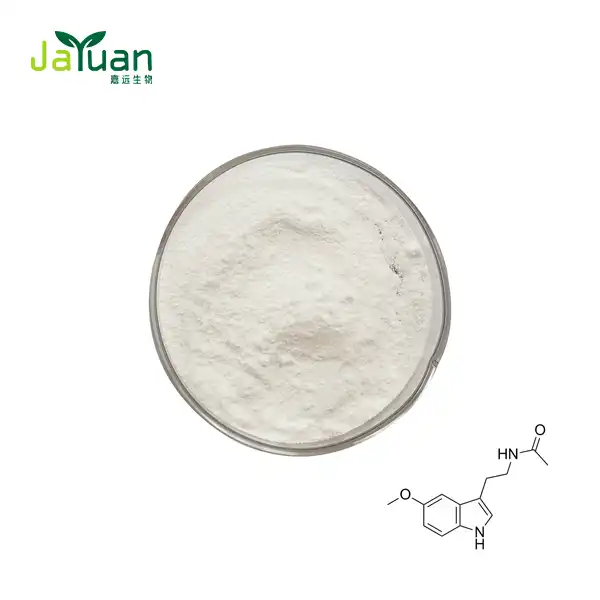
Melatonin is the indoleamine N-acetyl-5-methoxytryptamine, hormone synthesised in the pineal gland. It regulates the signals of the circadian rhythm and is still one of the most studied sleep regulating drugs in the world. When we talk about B2B components, “pure melatonin” means the man-made crystalline powder form, usually prepared to pharmaceutical standards, not a plant or mixed matrix.
Why Purity Grade Determines Ingredient Value
Any melatonin-based supplement ingredient's absorption and safety depend on whether or not it is free of related chemicals and solvents. USP 43 sets tight limits on chemicals that are related, such as the contaminant Peak E (1,1'-Ethylidenebis[tryptophan]), which has been linked to eosinophilia-myalgia syndrome in the past. For getting pharmaceutical-grade ingredients, you have to make sure they are at least 99.7% pure using HPLC and a fully itemized Certificate of Analysis (COA).
In addition to helping people sleep, pure melatonin is being used more and more in products that help with jet lag, getting used to working shifts, and making antioxidant-based beauty products. It is a popular ingredient in many types of products because it can be delivered through solid dosage, sublingual, and topical methods.
Comparing Pure Melatonin Formulation Types
Picking the right type of melatonin affects both how well the product works and how efficiently it is made. There are different technical requirements for each format that buying teams must compare to their production specs.
Here are the primary ingredient formats and their formulation implications:
- Crystalline powder for solid dosage: It is important for melatonin powder to have a controlled particle size distribution (D90 < 20 µm) so that it can be directly compressed in immediate-release pills and orally dissolving tablet (ODT) systems. Uniform bulk density stops capping and makes sure that doses are the same in micro-dose formulations (0.5–1 mg range), which are commonly used to support the circadian rhythm.
- Micronized powder for sublingual and liquid systems: We use micronized powder for sublingual and liquid systems because melatonin doesn't dissolve well in water (about 0.1 mg/mL), so it's used in sublingual strips or ethanol-pre-solution liquid drops. This skips the liver's first-pass metabolism and lets the effects start more quickly, which is important for formats that induce sleep right away.
- High-purity powder for sustained-release matrices: Pure melatonin powder supports extended-release tablet design by emulating the body's normal nighttime secretion curve when combined with HPMC polymers. To keep the matrix's structure, this application needs particles with a small size and very little water (≤0.5%).
These formulation requirements have a direct effect on the quality standards that purchasing teams should set for any company that makes pure melatonin. Suppliers who understand more than just the quality of the raw materials add real value to partnerships that use those materials.
Safe Use Parameters and Dosage Standards for Ingredient Sourcing
Melatonin supplements usually have between 0.5 mg and 5 mg of melatonin per dose. Lower doses (0.5–1 mg) help the body's natural circadian entrainment, while higher doses (3–5 mg) are more common in formulas for jet lag or shift work. These dose factors have a direct effect on the main ingredient's particle size, flowability, and blend uniformity needs.
Key Physicochemical Benchmarks for Pharmaceutical-Grade Material
Purchasing managers should check that the pure melatonin ingredient meets these confirmed standards: melting point between 117°C and 120°C (a main way to identify it), loss on drying ≤1.0%, waste on fire ≤0.1%, heavy metals <10 ppm, and specific optical rotation within the pharmacopeial range. If your ingredients don't meet these standards, you could get in trouble with the government when you try to register your goods.
How to Source High-Grade Pure Melatonin in Bulk
The most important step in getting melatonin ingredients is qualifying suppliers. Quality departments that are in charge of getting USP-grade or EP-compliant ingredients should give preference to manufacturers who offer batch-level COA documentation, third-party analytical verification (SGS, Eurofins), and two quality control systems: near-infrared (NIR) monitoring in real time and offline HPLC/GC-MS confirmation.
Changing providers can have an effect on your registration, which is a real worry. Re-qualification risk is much lower for well-known manufacturers with GMP and ISO 13485 certifications, process validation records, and data that is consistent from batch to batch. Professionals in procurement should also look at the profiles of liquid residues, the quality of the packing (nitrogen-sealed, light-resistant cases), and the minimum shelf-life guaranties. For well-stabilized crystalline material, this is usually 36 months.
When buying bulk pure melatonin ingredients, prices are set based on production volume, quality grade, and how well the supply chain works together. Manufacturers who produce 10 tons of goods a year can offer unit costs that are 40–60% lower than those of small-batch makers without sacrificing compliance with pharmaceutical standards.

Why Jiayuan Bio-Tech Stands Out as a Pure Melatonin Supplier
There is a range of technical and legal standards that different ingredient suppliers must follow. Xi'an Jiayuan Bio-Tech makes pharmaceutical-grade pure melatonin powder that is guarantyd to be at least 99% pure. They do this by using simulated moving bed (SMB) chromatographic purification, which is an ongoing process that keeps purity above 98% across production runs.
The dual quality control method at Jiayuan Bio-Tech includes both real-time NIR concentration tracking and offline HPLC and GC-MS analysis. This makes sure that every batch meets the standards set by USP 43, EP 10.0, and BP. Production lines that are GMP-certified and ISO 13485-certified help with regulatory submissions in China, the EU, and the US.
The factory is in Shaanxi Province, close to the Qinling Mountains. This is an area with easy access to raw materials and a history of biotech infrastructure. The company's liquid recovery method recovers more than 90% of the ethanol and methanol, which cuts costs without affecting quality. Nitrogen-sealed packaging keeps moisture levels below 0.5%, so ingredients stay stable for more than three years when stored normally.
Jiayuan Bio-Tech can meet the needs of both pharmaceutical-grade (≥99%) and cosmetic-grade (≥95%) specifications. They also offer small-batch customization for the creation of new compounds or tests of new formulations. Every order comes with full paperwork packages that include a COA, an MSDS, and a third-party proof report.
Conclusion
It takes more than looking at a purity figure to choose the right pure melatonin ingredient. Quality teams need scientific data that is written down, pharmacopeial compliance that is checked, and a provider that can make sure that each batch performs the same way throughout the production cycle. The minimum standard for responsibly sourcing ingredients is pure melatonin powder that meets USP 43 and EP 10.0 standards, is confirmed by a third party, and comes with full COA documentation. Jiayuan Bio-Tech meets all of these requirements by mixing cutting-edge technology for purification with strict quality control and flexible operations for the supply chain.
FAQ
1.What purity level should pharmaceutical-grade melatonin ingredient meet?
Pharmaceutical-grade pure melatonin should be at least 99% pure by HPLC, with all related substances controlled individually in accordance with USP 43 and EP 10.0 standards. For regulatory compliance, you need a full COA that lists the impurity profiles, heavy metal content, melting point, and loss on drying.
2.What third-party certifications should a melatonin supplier provide?
GMP certification, ISO 13485 certification, and the ability to provide analytical reports from reputable labs like SGS or Eurofins are all prerequisites for reliable pure melatonin suppliers. These papers help with product registration and show that the production process is legal.
3.How does particle size affect melatonin ingredient performance?
Bioavailability and mix uniformity are directly affected by particle size. For oral and ODT uses, micronized grades (D90 < 20 µm) are needed. Standard crystalline grades, on the other hand, work well for making solid dosages directly through compression. By specifying the right particle size distribution during purchase, problems with formulation can be avoided later on.
4.How should bulk melatonin ingredient be stored?
Pure melatonin powder can be damaged by light and rust. It should be kept at a controlled room temperature in containers that are sealed, filled with nitrogen, and don't let light in. Good suppliers offer packaging that keeps moisture in and loses no more than 0.5% when it dries, which means it can last at least 36 months.
Request a Sample or Bulk Quote from Jiayuan Bio-Tech
Jiayuan Bio-Tech sells pure melatonin powder that is safe for use in medicines to supplement makers, manufacturers, and study centers in the US and around the world. As a qualified producer of pure melatonin, we offer affordable factory-direct prices, full COA paperwork, and third-party analytical results. Our production is also GMP-certified. To get a sample or bulk quote, email our purchasing team at sales@jiayuanbio.com or sales1@jiayuanbio.com, or go to jayuanbio.com.
References
1. United States Pharmacopeia. USP 43–NF 38: Melatonin Monograph. United States Pharmacopeial Convention, 2020.
2. Brzezinski, A. "Melatonin in Humans." New England Journal of Medicine, 1997.
3. Ferracioli-Oda, E., Qawasmi, A., & Bloch, M.H. "Meta-Analysis: Melatonin for the Treatment of Primary Sleep Disorders." PLOS ONE, 2013.
4. European Pharmacopoeia Commission. European Pharmacopoeia 10.0: Melatonin Monograph. Council of Europe, 2020.
5. Hardeland, R. "Melatonin: Signaling Mechanisms of a Pleiotropic Agent." BioFactors, 2009.
6. Arendt, J. "Melatonin and the Mammalian Pineal Gland." Chapman & Hall, 1995.